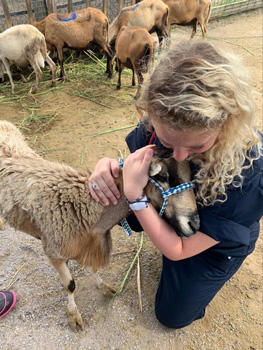
Earn Your DVM in Just 3.25 Years
Go from animal lover to extraordinary veterinarian
and follow in the footsteps of nearly 8,000 alumni
in the U.S., Canada, and beyond.
Earn Your DVM in Just 3.25 Years
Go from animal lover to extraordinary veterinarian
and follow in the footsteps of nearly 8,000 alumni
in the U.S., Canada, and beyond.


So you’ve decided you want to become a veterinarian. Now the questions are:
What classes do you need for vet school?
How does your undergraduate major fit into the picture?
Whether you’re studying biology, chemistry, or something outside the sciences entirely, building a solid pre-vet prerequisites checklist is the key to staying on track.
There’s no single “right” major for veterinary school. What matters most is completing the required courses for vet school, earning strong grades, and gaining hands-on experience with animals. A vet school prerequisites checklist organized by major can help you map out your path with confidence, regardless of what department your degree comes from.
Most AVMA-accredited veterinary programs require a similar set of foundational science and math coursework before enrollment. While each school sets its own specific requirements, typical veterinary school prerequisite courses include:
General biology with lab
General chemistry with lab
Organic chemistry
Biochemistry
Physics
Mathematics
Many programs also require humanities or social science electives, and some add courses like microbiology, statistics, or animal nutrition. The American Association of Veterinary Medical Colleges (AAVMC)’s 2026 prerequisite comparison chart provides a side-by-side look at what each veterinary school requires, making it a valuable planning resource.
These courses help build the scientific foundation you’ll rely on throughout your DVM program, from understanding how medications interact with the body to interpreting lab results and calculating dosages.
The veterinary school prerequisite courses themselves stay the same regardless of your major. What changes is how many of the vet school prerequisite classes are covered, and what gaps you’ll need to fill, possibly through a minor.
Do different majors have different vet school requirements? No. Every applicant must complete the same set of veterinary school prerequisite courses. But the amount of extra planning you’ll need depends heavily on which degree you’re pursuing.
Some majors tend to have more overlap with veterinary school prerequisites, while others leave a few gaps. This overlap can vary by institution, but you can always look at the prerequisite requirements for your desired veterinary schools and create a checklist accordingly.
Major | Main Focus | Prerequisite Overlap | Likely Gaps to Fill |
| Biology | Life sciences, cellular and molecular biology, ecology | General biology, cell biology, genetics, and labs are usually built into the program | Chemistry, organic chemistry, biochemistry, physics, math |
| Animal Science | Animal biology, nutrition, and husbandry; livestock management | Much of the biology and some chemistry requirements are covered through core courses | Organic chemistry, biochemistry, physics |
| Chemistry | Chemical principles, reactions, and molecular structure; lab techniques | General chemistry, organic chemistry, and sometimes biochemistry are covered | General biology with lab, cell biology or genetics, additional life sciences |
| Biomedical Science | Human and animal health sciences, disease mechanisms, and clinical preparation; select humanities/social science topics | Nearly all required science courses (biology, chemistry, organic chemistry, biochemistry, physics) are included in the standard curriculum, as are select humanities/social science courses | Minimal gaps; humanities/social science courses not already covered |
| Environmental Science | Ecology, earth systems, conservation, environmental policy | Some general science exposure, but programs emphasize ecology and earth sciences over molecular biology | General biology with lab, organic chemistry, biochemistry, physics |
| Psychology | Human behavior, cognition, research methods, social sciences | Limited overlap with core science prerequisites | Nearly all vet school prerequisite courses (biology, chemistry, organic chemistry, biochemistry, physics, math) |
A biology or biomedical science major may naturally fulfill most of the required courses for vet school through their program’s standard curriculum. An environmental science or psychology major, on the other hand, will need to layer additional science courses into their schedule alongside their degree requirements.
Neither path is better or worse for admissions, but each requires a different level of planning.
If your major leaves several prerequisite gaps, adding a minor in biology, chemistry, or a related science can be a strategic way to fill them. A minor allows you to complete required courses for vet school while earning academic credit that counts toward your degree, rather than simply stacking unrelated electives.
Biology majors who plan to apply to vet school are in a strong position because general biology, cell biology, genetics, and lab courses are already woven into most biology programs. To round out their vet school prerequisites, biology majors should prioritize organic chemistry, biochemistry, and physics as early as possible in their course planning.
For chemistry majors, prerequisite planning shifts to the biology side. General biology with lab, cell biology or genetics, and any additional life science courses that a student’s target vet schools require will need to be added through electives or summer coursework. Many chemistry majors find that a biology minor fills these gaps efficiently.
For animal science majors, vet school biology prerequisites are usually well covered through core courses. The key is to verify early on whether the program includes organic chemistry, biochemistry, and physics, since some animal science degrees don’t require all three.
Biomedical science majors tend to cover nearly all required vet school science prerequisites within their program’s standard curriculum, making this one of the most aligned majors for aspiring veterinarians. Students in this major should confirm that their program also satisfies any humanities or social science elective requirements for their target schools.
Environmental science majors who plan to apply to vet school require a more detailed game plan, since these programs often emphasize ecology and earth sciences over the cellular and molecular biology that vet schools prioritize. Students should expect to add courses in general biology with lab, organic chemistry, biochemistry, and physics outside of their major requirements. A chemistry or biology minor can help cover these additions.
Psychology majors require the most supplemental coursework, since psychology curriculums generally don’t include the core science courses that veterinary programs demand. Students will need to add nearly all of the vet school prerequisite courses into their schedule alongside the courses for their major. It takes more planning, but it’s completely doable, and the communication and behavioral science skills gained through a psychology degree can be valuable in veterinary practice.
The core science courses on a vet school prerequisites checklist build the foundation for everything you’ll study in a DVM program. For example, the core science courses in Ross Vet’s prerequisite requirements include:
Subject Area | Required Coursework | Credits |
| General Biology or Biological Science With Lab | Two semesters (or 3 quarters) | 8 semester credits (or 12 quarter credits) |
| General Chemistry (Inorganic) With Lab | Two semesters (or 3 quarters) | 8 semester credits (or 12 quarter credits) |
| Organic Chemistry With Lab | One semester | 4 semester credits (or 6 quarter credits) |
| General or Applied Physics With Lab | One semester Must have Algebra, Trigonometry, or Calculus as a prerequisite | 4 semester credits (or 6 quarter credits) |
| Biochemistry | One semester Must be an upper-level (300/3000 or higher) course with Organic Chemistry as a prerequisite | 3 semester credits (or 4-5 quarter credits) |
| Cell Biology | One semester Lab recommended but not required | 3 semester credits (or 4-5 quarter credits) |
| Mathematics | One semester of college-level Pre-Calculus, Calculus, or Statistics | 3 semester credits (or 4-5 quarter credits) |
| English | One semester of English Composition or another writing-intensive course Canadian students may satisfy English requirements in one of three ways: (1) one course or one semester of a course that had a 40% essay requirement for the overall mark in the course, (2) International Baccalaureate, or (3) Advanced Placement English. | 3 semester credits (or 4-5 quarter credits) |
| Advanced Science Courses | Suggested courses include Genetics, Physiology, Nutrition, Microbiology, Immunology, Organic Chemistry II, and Physics II. The Admissions Committee strongly encourages applicants to take a variety of upper-level (300/3000 or 400/4000) science courses to help demonstrate academic readiness for the DVM program. | 6 semester credits (or 9 quarter credits) |
| Humanities and Social Science Courses | Courses in communication and wellness are encouraged. | 6 semester credits (or 9 quarter credits) |
Graduate coursework will also be considered, but it’s not required to apply for a DVM program. CLEP B-level scores are also accepted, as long as applicants have the following:
General Biology with a passing score set at B-level equivalent to 6 credits
General Chemistry with a passing score set at B-level equivalent to 6 credits (Note: This cannot be used in place of Organic Chemistry. It can only be used for General Chemistry requirements.)
Calculus with a passing score set at B-level equivalent to 4 credits
Pre-Calculus with a passing score set at B-level equivalent to 3 credits
Biology and chemistry form the backbone of veterinary school prerequisite courses. General biology with lab introduces the cellular and organismal systems that underpin animal health, while cell biology or genetics dives deeper into heredity, disease mechanisms, and molecular processes.
On the chemistry side, general chemistry, organic chemistry, and biochemistry build the knowledge base for understanding pharmacology, metabolic pathways, and how medications interact with the body. Together, these courses prepare students to think critically about diagnosis, treatment, and patient care long before they enter a clinical setting.
Physics and math courses may seem less directly connected to animal medicine, but they strengthen the quantitative reasoning that veterinarians rely on daily. Calculating drug dosages, interpreting diagnostic imaging, understanding fluid dynamics in the body, and analyzing lab data all require a solid math and physics foundation. Veterinary school requirements in these areas vary, so students should confirm the specific credit hours and course levels their target programs expect.
Lab components develop critical skills in observation, data analysis, and scientific methodology that can’t be replicated through lectures alone. Students should prioritize in-person labs whenever possible, as many vet schools prefer this.
As previously noted, veterinary school requirements can vary by institution. Some programs require two semesters of organic chemistry rather than one, or add courses like statistics or systemic physiology.
The AAVMC’s 2026 prerequisite comparison chart makes it possible to compare requirements across every AVMA-accredited program side by side, so students can plan coursework that satisfies multiple schools at once.
Courses in microbiology, animal nutrition, anatomy and physiology, or statistics give students a head start on DVM coursework and help strengthen a veterinary school application. These electives go beyond the minimum required courses for vet school and signal to admissions committees that you’ve invested in building a deeper scientific foundation.
Most vet schools require documented hours working with animals, and Ross Vet requires at least 150 hours of veterinary professional experience or research. The most common ways to build these hours include:
Volunteering at animal shelters or rescues to gain exposure to a variety of species and conditions.
Shadowing veterinarians in clinical, farm, equine, or specialty settings.
Interning at veterinary clinics or hospitals.
Participating in research with faculty members or licensed veterinarians at your university.
The American Pre-Veterinary Medical Association (APVMA) hosts pre-veterinary symposiums and offers resources for students building their experience. Joining a pre-vet club on your campus is another effective way to connect with mentors and find opportunities.
Extracurricular activities matter, too. Leadership roles, community service, and diverse work experiences, including those outside of veterinary medicine, demonstrate the well-roundedness that admissions teams value.
The AVMA notes that vet schools are looking for well-rounded individuals who can bring strong leadership and communication skills to the profession. Ross Vet’s guide on veterinary experience for vet school applications covers strategies for diversifying clinical hours across different practice settings.
With so many courses to juggle, how can you create a checklist for vet school prerequisites that actually works? These strategies can help.
Ross Vet offers three flexible start dates—in January, May, and September—and accepts applications year-round. Whether you need one more semester to finish prerequisites or you’re ready to apply now, there’s a timeline that works for you.
Common prerequisites for vet school are the same regardless of major and typically include:
Biology with lab
Chemistry with lab
Organic chemistry
Biochemistry
Physics
Mathematics
Humanities or social science electives
The difference is how much of this coursework your major already covers. Those in science-heavy majors like biology, animal science, and biomedical science tend to fulfill more of these prerequisites through their program’s curriculum, while those in non-science majors will need to take these courses in addition to their degree requirements.
No, each applicant, regardless of major, must complete the same set of veterinary school prerequisite courses. What changes is how much overlap exists between the courses required for your major and those on your vet school prerequisites list.
The AVMA emphasizes that your undergraduate major does not factor into admissions decisions, so choose a major that keeps you engaged and motivated.
Start by reviewing the specific requirements for the veterinary programs you’re interested in, and then:
Core science courses typically include:
General biology with lab
Cell biology or genetics
General chemistry with lab
Organic chemistry with lab
Biochemistry
Physics
Mathematics
Some schools may also recommend or require microbiology, anatomy, or physiology. Always check the specific prerequisites for each program you plan to apply to.
Yes. While most vet programs require a similar set of prerequisite courses, some also have unique additions like statistics, animal nutrition, or English composition.
Ross Vet, for example, requires 6 credits of humanities or social science electives, encouraging courses in communication and wellness. The AAVMC’s 2026 prerequisite comparison chart is the most reliable way to compare requirements for veterinary school across different programs.
Building a vet school prerequisites checklist by major doesn’t have to be overwhelming. With early planning, the right advising resources, and a clear understanding of the requirements for your target veterinary programs, you can create an academic plan that sets you up for success, no matter what you choose to study.
Ready to learn more about Ross Vet’s DVM program and how your coursework fits in? Request information today to connect with the admissions team and take the next step toward becoming a veterinarian.
The information and material contained in this article and on this website are for informational purposes only and should not be considered, or used in place of, professional medical advice. Please speak with a licensed medical provider for specific questions or concerns. Ross Vet is not responsible for the information maintained or provided on third-party websites or external links.
Interested in learning more about a degree in veterinary medicine at Ross Vet?